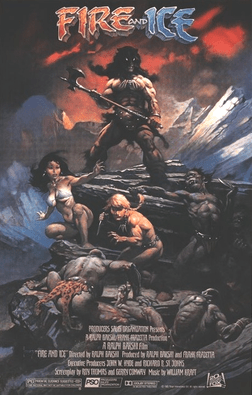
I am a HUGE fan of Ralph Bakshi. If you’re not familiar with him, Bakshi is the innovative director and animator of various independent adult-oriented animated films such as Coonskin (1975), American Pop (1981), and Fritz the Cat, which was the first animated film to receive an X rating. While most animated films up until that point were aimed mostly towards children, Bakshi made his films specifically for an adult audience in mind. Fritz the Cat, for example, contains large amounts of nudity and swearing and explores ideas concerning hedonism, racism, liberalism, and the concept of free love. And that’s just one movie! Discovering Bakshi’s films was something of a shocking revelation for me. He showed me, and countless filmmakers, that animation could be made for so much more than merely family entertainment, and he widened the borders of possibility for the genre. Also, I had heard that his movies had a lot of nudity in them. Give me a break; I was a teenager!
Though most of Bakshi’s films are set in urban America, he dipped his toe into the fantasy genre a couple of times throughout his career with his own original science-fantasy film Wizards (1977) and his adaptation of The Lord of the Rings (1978). He also made Cool World (1992), but we don’t talk about that. EVER. The point is that he had proven on two separate occasions that he was capable of making fantasy films. With the sudden popularity of sword and sorcery films like Conan the Barbarian (1982) and The Beastmaster (1982) heralding the 80’s fantasy movie trend, the moment for Bakshi to stake his claim on the decade and the genre was ripe. While Fire and Ice is by no means a horrible film, it certainly isn’t the decade-defining fantasy movie I would have hoped for from Bakshi, nor is it even his best work by his standards.
Based on a setting and characters created by Bashki himself and artist Frank Frazetta, Fire and Ice takes place in the fantastical world of…..um……Earth, I guess? It’s never given a name, but it’s clearly inspired by the world of Robert E. Howard and the style of Heavy Metal Magazine. Anyway, the movie starts with some exposition that explains that the evil Queen Juliana (Susan Tyrrell) and her son Nekron (Stephen Mendel) are hellbent on ruling the world, and do so by sending wave after wave of magical glaciers across the land. The ice wave forces most of humanity to evacuate towards the equator, where they build their new humble abodes out of mountains and volcanoes. Nekron eventually sends a delegation to King Jarol (Leo Gordon), who rules the citadel of Firekeep. It’s assumed that Nekron wants to discuss King Jarol’s terms of surrender. But it turns out the delegation is a distraction so that Nekron’s minions can abduct Jarol’s daughter Princess Teegra (Maggie Roswell), and Nekron can produce an heir. Teegra eventually eludes the sub-human lackeys by using her feminine wiles (it also helps that the sub-humans are dumber than a bag of sand), and she conveniently runs into Larn (William Ostrander), a warrior and only survivor of a village that was destroyed by one of Nekron’s icy escapades. And wouldn’t you know it, they’re both horrendously attractive and fit! They’re practically made for each other! Larn offers to guide Teegra back to Firekeep, and then a bunch of sword and sorcery malarky happens after that.

Starring Amanda Seyfried in a role that will leave you breathless.
Bakshi uses rotoscope for Fire and Ice, which is essentially the process of shooting scenes in live-action and drawing over them, giving the animation a more life-like quality. Bakshi is no stranger to this technique since he used it in Wizards, The Lord of the Rings, and American Pop. The animation is excellent and well-drawn, though compared to his previous works, it’s somewhat inconsistent. There are moments where the movement of the characters are flowing naturally but then are abruptly halted or interrupted as if the animators decided to cut the rest of the action because of time, money, laziness, or a mixture of all three. The backgrounds, done by James Gurney and Thomas Kinkade, are also very good, but again, they are also inconsistent. There are many shots and backgrounds in the film that are incredibly intricate, detailed, and imaginative, but there are also many other backgrounds, particularly the ones that take place in the jungle, that look more abstract and rushed. Again, I think this was either a time or money issue. They probably were pressed to get this film out on time by 20th Century Fox and had to resort to an abstract art style to do so. They still look pretty, but it clashes with the tone set by the various backgrounds in the rest of the film.

Stuff like this is pretty cool, though.
I hate to sound like a broken record, but when comparing Bashki’s earlier fantasy works to this one, it comes up dreadfully short. Wizards, for example, has many mature underlying themes, including the moral ambiguity that lies within technology, the dangers of propaganda, and the concept of fascism. Only Ralph Bashki could insert these ideas into an animated fantasy film and make it work. Fire and Ice, however, has the oh-so-interesting theme of half-naked barbarian people wandering around, getting kidnapped, and getting into fights for an hour and 20 minutes. The pacing is pretty weak, and almost nothing of consequence happens in the entire middle act of the film. It’s just fighting, talking, the princess getting kidnapped, and more fighting. Riveting stuff. While nothing happens for 40-ish minutes, all I’m left with are my thoughts, and many questions fill my head as the film progresses that are never answered. What are Queen Juliana and Nekron’s motivations for wanting to rule the world? How do they know magic? How exactly does magic work in this setting? What was Darkwolf’s (Steve Sandor) personal motivation for wanting Queen Juliana and Nekron dead? Sure, they’re bad people causing serious harm, but it’s implied that Darkwolf has a personal beef with them, so what was it? Why does he live alone in the wilderness? What was the deal with that weird witch lady Roleil (Elizabeth Lloyd Shaw) and her lanky caveman son/servant Otwa (Mickey Morton)? They show up for 10 minutes after kidnapping Princess Teegra, and then are immediately killed by the sub-humans who kidnap Teegra again! Who were they? What was the point of putting them in the movie?! I HAVE SO MANY QUESTIONS!!!
It doesn’t help that the characters we’re stuck with are staler than hardtack. Everybody in this film is a generic fantasy trope, from the heroic and brave hero to the busty princess who gets captured a frustrating amount of times, to the evil villain who desires power, spits on the concept of peace and enjoys burning down orphanages filled with puppies because that’s how he rolls. The only person I was slightly attached to was Darkwolf, a dude dressed in animal skins who helps Larn on his quest to rescue Princess Teegra and defeat Nekron. Not because he’s the most fascinating character in the world, but because I thought that he looked and sounded cool. He’s like a caveman version of Batman or Wildcat from DC comics if they had an axe. He’s nothing special, but I’m trying to find something to grab onto here.
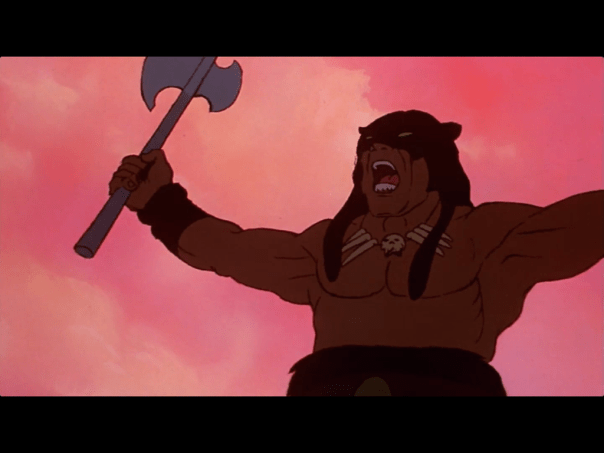
Darkwolf performing Nessun Dorma from Giacomo Puccini’s opera Turandot. “Vincerooooooooooò! Vinceroooooooooooooooooò!”
If Fire and Ice were directed and drawn by some random schlub filmmaker, I’d pass it off as a below-average fantasy movie. But this was a movie from Ralph Bakshi, who even when he had to cut corners for his other films, still made them worth watching with mature and thought-provoking content and commentary. Fire and Ice is nothing more than a predictable and basic fantasy story. Bakshi has always been above that, and why he didn’t jump at the chance to insert more of his ideas into this genre is beyond me. Perhaps he peaked when he made Wizards and didn’t have anything more to add? I’m not sure. I’d only recommend this film to major fantasy buffs who want to see some pretty pictures and decent rotoscope, but there’s not much to say about it except that it’s not as bad as Cool World. I’m not mad, Ralph. I’m just disappointed.

God, this movie was an eyesore.

 The Bard of the Reel