Good day! I’ve decided to add a new section to this blog, which I’ve called “Fantasy Ramblings.” Instead of talking about a specific fantasy movie, I’ll be rambling about a fantasy-related topic or character that I love or despise. I’ll start this new segment by talking about one of my favorite concepts and characters from the Planescape setting of Dungeons and Dragons, Her Dread Majesty, The Lady of Pain.
Before I get into the Lady of Pain, a little context is needed. Planescape is a campaign setting in the Dungeons and Dragons roleplaying game where your characters travel across the numerous planes of existence in the D&D multiverse. There’s are multiple books that get into the nitty-gritty on how the Planescape cosmology works (and I would recommend reading them because they’re really cool), but I’ll simplify it this way: Think of the multiverse as a big wheel. Within the wheel are multiple regions that represent numerous aspects of reality and also act as physical locations. Within these regions are various layers of planes that get into those specific functions.
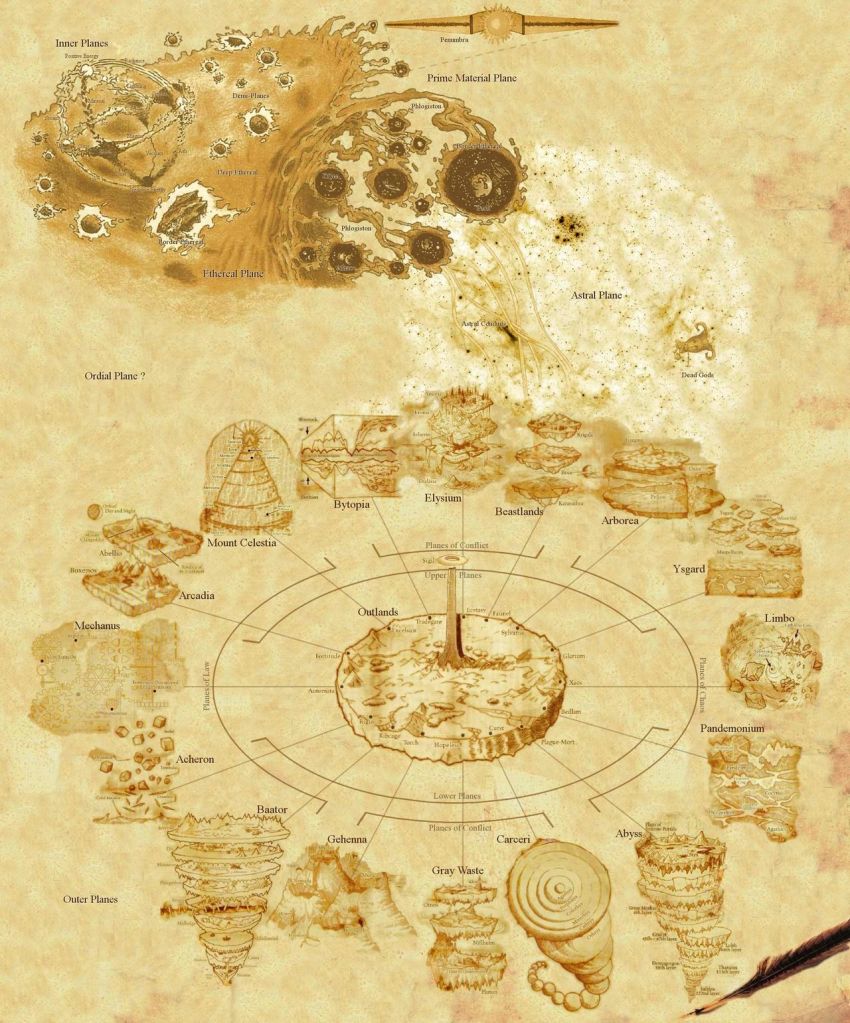
For example, the Inner Planes make up all of the multiverse’s elemental matter, so entire planes within that region are made up of fire, water, earth, etc. These planes are physical embodiments of the elements they represent and also act as the primary sources of the elements present in the cosmos. The Outer Planes are the homes of various pantheons of gods, demons, and devils, and each domain in which they live is representative of an ethical alignment. Everybody goes there once they die, and depending on how you lived your life, you’ll either be chilling out with your patron God in existential and physical bliss on Mount Celestia, or you’ll be getting magma poured in your eyes with a pitchfork in your ass for eternity in one of the nine layers of Hell (I wouldn’t recommend going there). And of course, there’s the Prime Material Plane, which is typically the primary setting for any standard D&D campaign. There are many more planes to discuss, and so much more to the Planescape setting and the concepts it introduces, but for the sake of brevity, I’ll leave it at that. The multiverse is a wheel, and there’s lots of stuff in it. You get me?

At the center of the wheel that is the multiverse (which is technically impossible because the multiverse is infinite, but that’s what the books say), there’s a plane known as the Outlands, which is a domain of true neutrality. At the center of the Outlands, is a giant spire that shoots straight up into the sky infinitely. At the top of this infinite spire (which is also impossible), there’s a city-sized ring. Within this ring is a very strange city known as Sigil, the City of Doors.

Sigil is the Mos Eisley Spaceport of the multiverse. It’s a place where people from all walks of the infinite realities use as a trans-dimensional rest stop. Some people live there, others use it to buy supplies for a quest in another plane, and some use it for shady business deals. Again, like Mos Eisley, Sigil is not a nice place. You literally cannot go five steps without getting sized up by dagger happy pickpockets and streetwalkers. But there’s always something interesting to see. There’s a dude that sells various flavors of hyper-intelligent rats on a stick, a brothel that focuses on slaking intellectual lusts rather than physical ones, and a bar called the “Smouldering Corpse Bar” where the main attraction is a dude in the middle of the room who is endlessly on fire. Sigil is kind of nuts.

Sigil is called the City of Doors because of its peculiar relationship with portals. The only way to get to Sigil is to go through one of the many portals across the multiverse. If you travel around Sigil, you’ll notice that there are many portals in various parts of the city. Some of these portals can take you to other places in Sigil or take you to different parts of the multiverse. Not only can you never truly tell where a portal is since they seemingly appear at random, but you can only access a portal with a specific “key.” Now when I say a key, I don’t mean a literal key (though it could be). A particular portal can only open if certain perimeters meet. For example, a portal could open because you recently washed your hair. A portal could open for you if you fondly reminisce on your childhood while jumping on one leg. It could open for you if you etch a regret into the palm of your hand with a knife. It may only open for two specific lizardfolk. You can never tell what the key to the portal is or where it leads. You could be casually walking down the street and BAM! You’re in Hell now for some reason, and you get torn apart by demons. Whoops! It’s a good hook for an adventure.
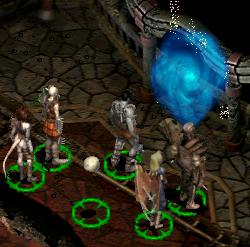
Specific portals have been mapped out by various Sigil inhabitants with longer lifespans and too much time on their hands. But the portals can also change locations at a moment’s notice, and a majority of the portals are either undiscovered or impossible to dissect. “What’s the deal with these portals?” You may be asking. “And why does this city exist?” That, my friend, is a good question. With that, we can finally get into the Lady of Pain.

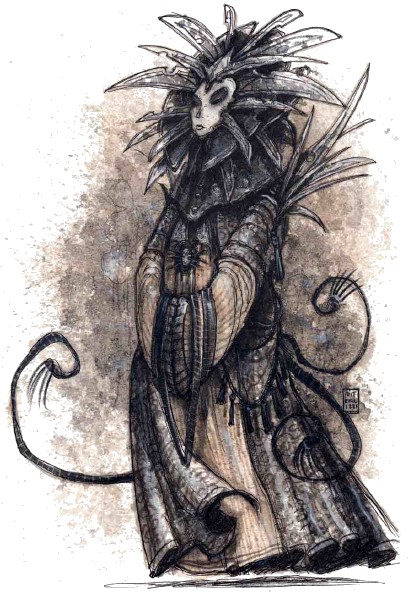
The Lady of Pain is the enigmatic and immortal ruler of Sigil, and the one who controls the portals located throughout the city. She is a rather stoic individual wearing a long robe and a headdress adorned with an excessive amount of blades. She never speaks. Nobody has ever heard her speak in the amount of time she’s been in Sigil (which is forever). She isn’t seen in public that often, but you may see her hovering around the city. If you do see her, however, here is my single piece of advice for you:

RUN. Turn 180 degrees in the opposite direction and run. Do not look at her. Do not talk to her. Do not go near her. Do not look back. Run until the hairs on your back no longer stand on end, then run some more. Run for miles if you have to. Then find a good hiding spot and lock the door behind you. If your hiding spot doesn’t have a door, make one from scratch. Then sit in a corner and hope to every single God that has ever existed that she didn’t see you. I will repeat it just so we’re crystal clear: RUN. Why? There are many reasons. Let me fill you in.
- The God’s can’t touch her.
One of the many perks of being a God in D&D is that they can pretty much do whatever and go wherever they want. There is one place, however, that the Gods cannot go, and that’s Sigil. Why? Because the Lady of Pain won’t let them in. Let that sink in for a second. The Gods of the various pantheons, from Zeus to Odin, to Rao, and Tyr, these beings of infinite wisdom and power who are capable twisting fate and reality to their own needs, are unable to access a single city because some crazy floating lady doesn’t want them to. As you can surmise, this frustrates them. Many Gods would be extremely pleased to be in control of Sigil. They could control the portals and send their minions and worshippers to anywhere in the multiverse they wanted. Spreading their gospel and conquering other realms would be easy-breezy. But as I said, they can’t. Because the Lady of Pain says no. And they can’t do anything about it. In short, the Gods are nothing to her. So what the hell does that make her?
2. She will kill you for any or no reason at all.
The Lady of Pain is not what you would call a people person. Anybody who attempts to communicate with her or even gets near her gets killed. Anybody unlucky enough to cross her path is flayed, mutilated, exploded, or chopped into bacon bits and strewn about the city. I’m talking Mortal Kombat levels of murder. Once she’s done, there’s barely anything left. What sets her off? Pretty much everything. You get in her way; you’re dead. You try to talk to her; you’re dead.You bully her servants, the Dabus, who are working all over Sigil; you’re REALLY dead. You try and worship her, oh my god, you’re double dead! If there’s anything she hates more, it’s people who try to worship her. I don’t know why, but she does. Which is pretty interesting considering the cyclical nature of belief and worship in Planescape. The Gods bless their worshippers with boons and good fortune, while their worshippers return these with further belief in their Gods’ existence, which gives the Gods their power. Both benefit from each other, and both would be nothing without the other, like a sort of divine mutualism. Which is why the Lady of Pain’s existence is so paradoxical. Nobody worships her, yet not only does she exist, but she has powers beyond imagining.
Some people have attempted to build a religion around her in appreciation for keeping order in the city. They’ve taken to the streets, preaching her gospel to the masses (she doesn’t have one, so I guess they just made some stuff up). These religions don’t tend to last very long because the Lady makes a beeline for them and kills them. HARD. You want to know the sickest thing about this? The ones who get killed in these horrendously gory ways are the lucky ones. Because…….
3. The Lady of Pain can maze your ass.
Getting flayed alive and impaled on a spike may not sound fun, but it’s preferable to the worst punishment The Bladed Queen can dish out: her mazes. Pretty much everything pisses her off, but if you make her REALLY mad (why would you do that?!), she can maze you. Mazing, as you can probably guess, is when she teleports you to a maze of her design. When I say maze, I don’t mean like a corn or hedge maze (though the Lady could make it like that if she wanted to). The maze is a pocket dimension filled with a variety of wrong turns, illusions, death traps, monsters, Jehovah’s Witnesses, and whatever else she wants to put in there for your displeasure. The rules to the maze and how it looks can be whatever the Lady of Pain wants it to be. The only consistent rule through every maze she makes is that it must have an entrance and an exit. Otherwise, it wouldn’t be a maze. I guess even the Lady of Pain has a sense of fair play. Good luck finding the exit, though, because it’s usually impossible. The maze is typically designed to mess with you at every given turn, so it’s easy to lose track of where you are and how long you’ve been traveling.
But don’t worry, you’ll have plenty of time to find the mazes’ pattern. An infinite amount of time, in fact! When you’re in the maze, you cannot eat, sleep, age, or die. All you can do is move forward. And with that, the Lady has gifted you with a fate worse than death. After an eternity of wandering, continually fighting off demons, trying to discern between reality and the illusions made by the maze, and thinking that you’re so close to the exit only to find another dead end, you’ll be begging for the Lady to kill you so your suffering can end. Of course, she won’t comply, and your mind and soul break, turning you into an insane, gibbering husk of your former self. You really should have left that Dabus alone.

4. You cannot fight or harm the Lady of Pain. No, seriously. You can’t.
Dungeons and Dragons players are an interesting bunch. When they start with their level 1 character, you can see all the burgeoning potential in their eyes. It is your job as the DM to guide your players through their adventures as best you can so that they can defeat the impending darkness, develop their characters, and have fun along the way! It’s important to remember, however, that power can corrupt the purest of souls. Once your players get strong enough, let’s say level 17 or 18, almost nothing is a challenge anymore. They’re practically demigods in their own right, and nothing you throw at them can take them down. At that point, the game is no longer about being heroic and growing as a team. Now it’s about planting their flag on as many defeated foes’ corpses as they can to regain the feeling of a hard-earned victory, even if it’s absolutely insane and disregards their characters’ established alignments. Doesn’t matter. Their stats are ginormous now. They’re drunk on power, and they want that street cred. Who else can they take? The players start scouring through the monster manuals for the big boys. An Ancient Black Dragon, the Demogorgon, a Beholder, even the Tarrasque if they’re feeling especially ballsy (and stupid). Once the Prime Material Plane exhibits no more worthy foes, the players look towards the divine. Off they go to Mount Celestia to kick Thor’s ass. Why? Because they can. This is not a joke. I’ve seen this happen.
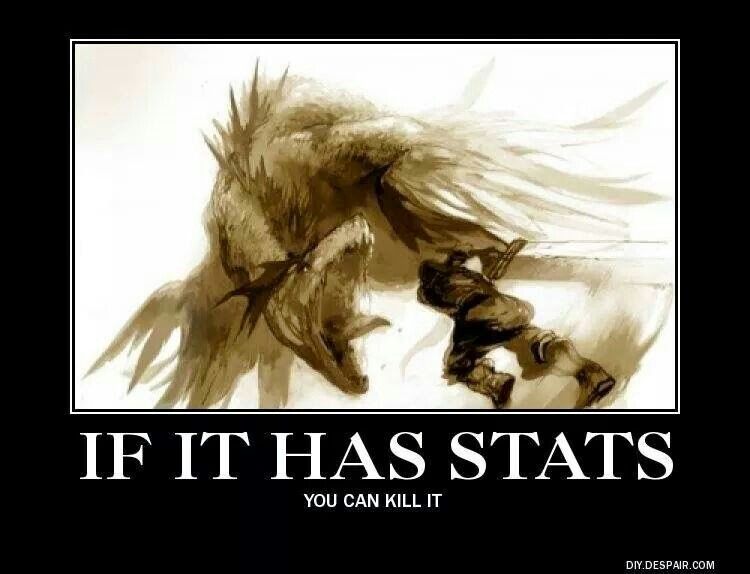
When the party eventually reaches Sigil, they’ll naturally hear of the mysterious Lady of Pain. “We can take her!” the fools boast. They can’t. Because she has no stats. Practically everyone in Dungeons and Dragons has stats that you can draw upon if you look hard enough. Everybody from the tiniest gnome to Ra, God of the Sun. Sure, fighting a God or any of the other strong creatures I’ve mentioned is exceptionally challenging, if not nearly impossible. Still, if you are at a high enough level, have the right equipment, strategize with your party, and are very lucky, victory is conceivable. There is no reality in which victory over The Lady of Pain is assured. You will lose. There are no numbers to crunch. That’s not how the Lady of Pain works. She defies the very rules of Dungeons and Dragons. If you fight her, you will die. No exceptions. No roll will damage her, no roll can save yourself from her, and there is certainly no roll you can make to take your stupid decision back. The only hope you have is to hide your character sheet from the DM so they don’t put it in a paper shredder.

This is why I love the Lady of Pain, and by extension, one of the many reasons I love Planescape. She defies definition. Planescape is a setting where the secrets of the universe are laid bare. There are maps to the Gods’ homes, the turning of the celestial spheres can be witnessed and explained, and practically everything and everyone has a backstory. The Lady of Pain, however, is a complete mystery. We don’t know her origins, what she wants, why she kills anyone who gets close, favorite color, nothing! She simply exists. There have been many theories as to who she is: Some say that she predates the beginning of the universe and created Sigil. Others say that the city is a cage, and she is its prisoner. It has also been suggested that she is six giant squirrels in a robe, headdress, and a ring of levitation and illusions. I think the last one was thought up by someone who drank a bit too much bub. Either way, nobody has any idea what her deal is, and she’s certainly not interested in sharing. She’s also an excellent deterrent for players attempting to derail a DM’s campaign in Sigil. Are the players goofing around too much or not working with the story you’ve laid out? The Lady of Pain will break their backs and make them humble. She is essentially the personification of the DM saying no. In a multiverse of explanations, she is the one true question that cannot be answered, and I find that to be fascinating. Be wary of your actions in the City of Doors. The Lady of Pain may take offense to it. And if she does (say it with me now), RUN.

 The Bard of the Reel