Curses are cool, aren’t they? They’re a prevalent and multi-faceted plot device both in and outside of the fantasy genre that sometimes leaks into real life. If you’re a spiteful person who wants to ruin someone’s life, there’s plenty of different kinds of curses from all sorts of times and places that you can leaf through. You got your sleeping curses, biblical curses, family curses, sports curses, the Scottish curse, hoodoo jinxes, witchcraft hexes, and the classic Egyptian mummy’s tomb curses. I have had a personal vendetta against various showrunners of the modern Doctor Who series for years now, and I can’t decide if I should unleash upon them a flesh-eating scarab curse or an intermittent incoherent babbling curse. It’s like shopping for a table at Ikea. There are just so many options!

The curse in Ladyhawke is a unique fusion. A deal with devil curse, and an animal transformation curse. In medieval Italy, the captain of the guard of Aquila, Ettiene of Navarre, (Rutger Hauer), and the Comte d’Anjou’s daughter Isabeau (Michelle Pfeiffer), are in love. Mad with jealousy after Isabeau rejects his advances, the Bishop of Aquila (John Wood) goes full incel and invokes a satanic curse on the couple. Isabeau transforms into a hawk by day, and Navarre a wolf at night. Both are doomed never to see their true love again as they truly are while also being hunted by the Bishop. “The voice of the wolf that we hear is the cry of Navarre.” The character of Father Imperius (Leo McKern) explains. “Poor, dumb creatures with no memory of the half-life of their human existence, never touching in the flesh—only the anguish of a split second at sunrise and sunset when they can almost touch…but not.” The movie starts from the perspective of Phillip Gaston, a thief with the nickname of “Mouse” (Matthew Broderick), who bumbles into the couple on the run. By sheer coincidence, Phillip has just escaped from the Bishop’s dungeons in Aquila. He is very familiar with the layout, making him an essential and unwilling part of Navarre’s plan to enact his vengeance against the Bishop.

Let me start this off by saying that I love the story’s main hook: the cursed couple of Navarre and Isabeau. It’s a kind of tragic yet romantic fairy tale story that brings out a variety of nostalgic feelings, like the kind of story that was read to you as a kid that made you believe that magic was real. Though I never envisioned an orchestral synth-pop/rock soundtrack like the one Ladyhawke has when my dad read Peter Pan to me. That probably would have made it ten times more awesome.
Various people make the main focus of the story work so well. Firstly, the actors who play the couple, Hauer and Pfeiffer, who both exude their distinct brands of amicability and sadness. They both speak of their significant other to Mouse throughout the film, and their pain and suffering are abundantly clear through their performances. They don’t even need to say anything. There’s plenty of moments where everything they’re feeling is shown through their looks alone. They are incomplete without each other, and you desperately want to see them break the curse and finally be together, and also to give them a massive group hug.

Of course, I think part of what makes the dialogue feel genuine is the director, Richard Donner (Superman, The Goonies, etc.). One of his biggest strengths is making corny dialogue and ridiculous concepts sound authentic. This is the man that made us believe a man could fly, remember? A woman turning into a bird is basically the same concept. There’s plenty of moments in the movie where a line or an action could have looked or sounded awkward, but Donner guides the performers in a way that makes it feel believable, even dramatic if the tone calls for it. For the most part, anyway. We’ll get to the BIG Broderick exception in a bit.
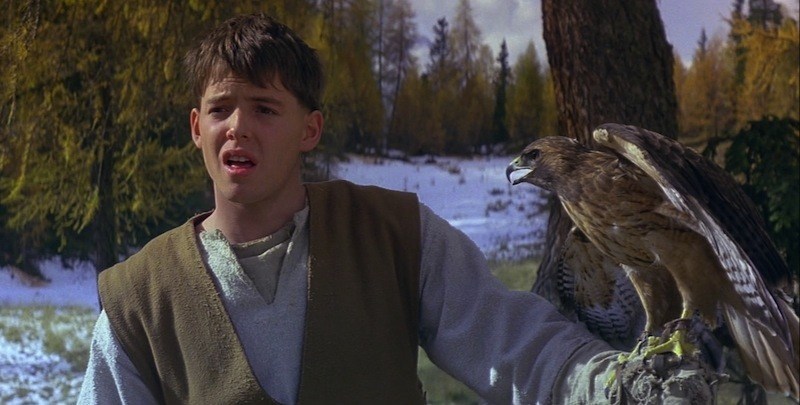
Ladyhawke also looks fantastic in terms of its setting and cinematography. Vittorio Storaro (Apocalypse Now, The Last Emperor) gives us some beautiful fantasy imagery that contributes to the film’s romantic tone. Dark forests, medieval cathedrals and castles, flowing streams, rocky mountains, and perilous frozen rivers, all shot in rich color saturations befitting the traditional fantasy style. Storaro’s filmmaking philosophy goes back to Johann Wolfgang von Goethe’s Theory of Colors, which claims, in part, that colors have certain psychological effects on the viewer. Much like how Donner manages to gain a surprising amount of investment through his direction, Storaro does the same through his cinematography, grabbing the audience’s attention through his beautiful shots of landscapes, use of color, and lighting. “It shore is gosh-darn purty” is what I’m getting at.


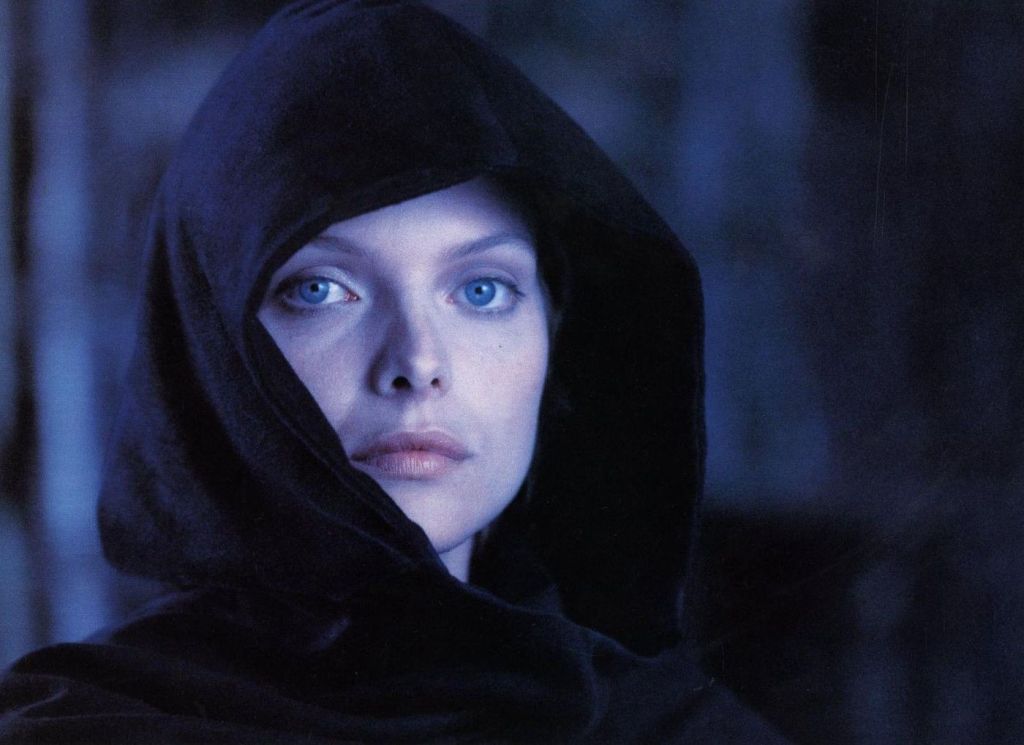


While Navarre and Isabeau’s plight is tragic, there’s an even bigger tragedy attached to this movie. Despite my previous gushing about how good it looks and how much I like the romance, Ladyhawke sadly doesn’t make the classic fantasy movie mark in my eyes because of one huge misstep. That misstep is Matthew Broderick as Mouse. Remember when I said that Donner manages to direct the actors admirably and make their characters feel real despite how cheesy and awkward their lines might be? Donner’s direction is noticeably missing from Broderick’s performance. The movie is mostly told from his perspective, unfortunately making him the main character, and he also serves as the comic relief. I’ve heard other critics call his performance anachronistic since he’s a constant quipper in a medieval fantasy setting. That’s not quite the word I would use. Anachronistic implies that he’s doing something that people wouldn’t do at that time point in time, and I’m reasonably sure sarcasm and jokes existed in medieval Italy. No, the two words I would use to describe his performance is annoying and disruptive.

His main schtick is that he almost never shuts up. He’s either making unfunny observations about the events unfolding around him, talking to himself, or complaining to God for his misfortunes. Yeah, he talks to God a lot in this movie (He never answers, probably because he doesn’t want to deal with this irritating ass rash of a person) whenever bad stuff happens to him, either bargaining for mercy or making sarcastic quips. It gets old, REALLY fast. I think that’s why I appreciate some of the more quiet and picturesque moments with Navarre and Isabeau because the imperfect form of Ferris Bueller isn’t there to poke his head in and ruin the moment. And even then, some good scenes are rendered lesser in their potency due to his presence, and he disrupts the tone on a multitude of occasions. And then, of course, there’s the differently flavored, but equally vexing fact that Broderick can’t decide between a European or American accent. If he were a minor character, then he probably would have merely been a troublesome footnote. Still, as I said earlier, the movie is mostly told from his perspective as the main character, so he’s in the majority of the runtime. And what’s worse, he’s necessary to the plot because he’s seemingly the only one who can get Navarre and Isabeau into Aquila.
The pacing of the movie isn’t great, either. There’s a lot of aimless wandering for a good chunk of the film, and we’re just waiting for Mouse to get clued in on the story of the lovers so that he can develop empathy for somebody other than himself. But even when he learns their backstory, Ladyhawke continues to devote its time to wander around some more, actively refusing to continue the story at times. The movie runs for about two hours, but I think a good twenty minutes’ worth of pointless scenes could be shaved off. I feel comfortable with this amount of minutes because there would be a one hundred percent chance of less Broderick.

I hate ragging on Ladyhawke because its potential for being a modern fantasy masterpiece is staggering. It’s direction, cinematography, music, and spin on the cursed lovers trope is phenomenally well implemented! But Matthew Broderick’s performance threatens to undermine all of that with its tone-deafness and unrelenting unfunniness. It’s such an easy fix, too! The screenwriters, Edward Kharma, Michael Thomas, Tom Mankiewicz, and David Peoples (Jesus, no wonder this script isn’t the cleanest if there’s four people attacking it from all sides), could have either got rid of Mouse entirely and made the movie a straight-up drama, or if they really wanted to have a comedic character, maybe it would have been better to have him as a supporting character and tell the story from Navarre and Isabeau’s perspective. Giving them something funny to say would also help. From there, the flow of the story would probably get unclogged and go at a smoother pace. Unfortunately, what we’re left with is a film that’s only good for a small portion of its runtime, but I think it’s a meaningful portion. It just sucks that we’re stuck with a character that is not only unlikeable, but is essential to the story. It’s as if the audience is also cursed with being unable to press the fast forward button.

 The Bard of the Reel